The authors of the text are Barbara Ružičić, Petra Magdalena Ružičić and Demir Mekić.
Bridges of Solidarity in Sarajevo
Sarajevo, a city inextricably connected with a layered history as well as a deeply traumatic past, hosted a group of young activists from Serbia and Croatia as part of a study visit organized by the Youth Initiative for Human Rights (YIHR). Activists from Serbia handed letters of solidarity to the citizens of Sarajevo, victims of the Markale market massacre, as a symbol of solidarity and compassion for the suffering from 1994.
The program, implemented with the support of the Friedrich-Ebert-Stiftung (FES) foundation, enabled participants to visit key historical locations directly connected with the period of the siege of Sarajevo in the nineties. The young participants directly confronted and became acquainted with monuments and testimonies from the period of the siege, and themselves recognized mistakes from the past in order to, guided by understanding and empathy, build a foundation for a more stable and humane future of this region.
The first day of the stay began at the Vrbanja bridge known as the Bridge of Suada and Olga, a bridge that symbolizes the beginning of the siege of the city. Guided by historian Nicolas Moll, participants learned about the circumstances that accompanied the transformation of the then Bridge of Brotherhood and Unity into the site marking the beginning of the siege of Sarajevo. The fate of the Italian humanist Gabriele Moreno Locatelli, tragically killed at this place during anti-war protests, was also mentioned, leaving a lasting mark of solidarity alongside the one left by Olga and Suada.
The educational walk continued towards the Jewish cemetery, where participants had the opportunity to see unique tombstones that testify to the meeting of cultures in Sarajevo. Historian Moll, explaining stories about important persons buried at this site, also spoke about the importance of preserving the understanding of the shared cultural heritage of a multicultural city such as Sarajevo.
One of the most emotional moments of the day was the visit to the memorial room “Sarajevski spomenar”. Accompanied by representatives of the Association of Parents of Murdered Children of Besieged Sarajevo, participants became acquainted with the consequences of the siege of Sarajevo. It is important to mention that the focus of this visit was not exclusively on facts, but on personal destinies and the impact of war on the everyday life of the citizens of this city. The program that day ended with a visit to the Yellow Fortress, a symbol of survival and continuity despite the war, where, overlooking the city, the young participants summarized their impressions and reflected on the day through a joint conversation.
The second day began with a visit to the Kazani memorial site, guided by Edin Kanka Ćudić, from the Association for Social Research and Communications (UDIK). During the visit to Kazani, the young participants directly became acquainted with the facts about crimes committed at this location, learning about the suffering of all victims regardless of ethnic or religious differences. In this context, the role of UDIK was particularly highlighted, as an organization that has for years consistently advocated for documenting and marking this site of suffering.
After visiting Kazani, the participants were received at the City Hall by the deputy mayor Predrag Puharić. Considering that institutional support for topics dealing with dealing with the past is still rare, the reception at the City Hall and its tour represented a significant gesture of respect and support for the youth.
A particularly striking part of the day was the visit to the monument dedicated to the killed children of Sarajevo, with expert guidance by Tamara Zrnović from the Center for Nonviolent Action. Such an approach enabled the group of young people to, in an impartial way, encompass and pay tribute to victims from all sides of the conflict.
The day ended with regional networking. Young people from Serbia met their colleagues from Croatia at a joint dinner, which opened space for direct conversation, mutual exchange of opinions and necessary summarizing of previous experiences.
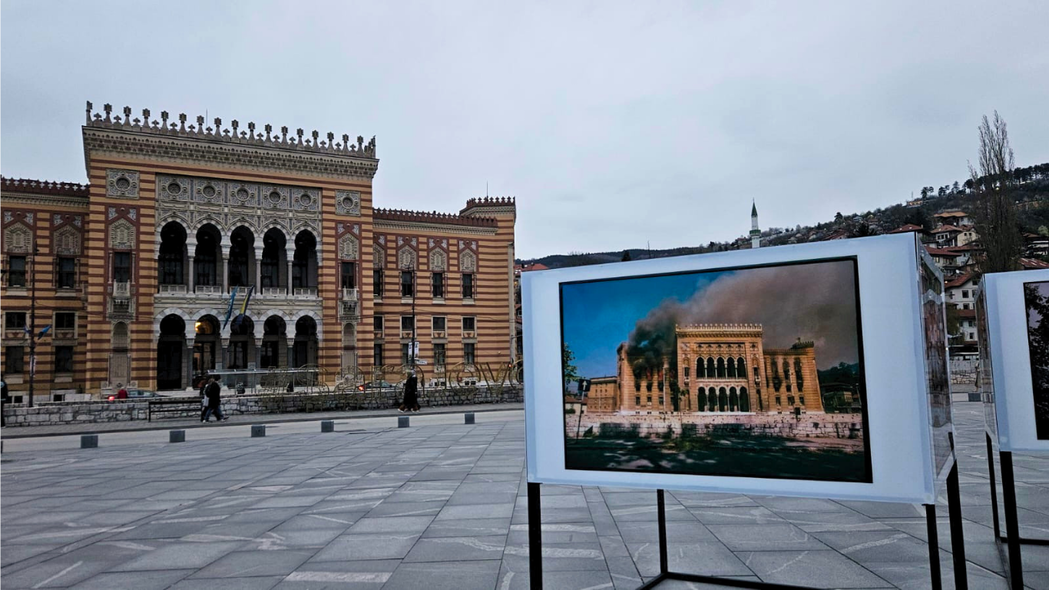
On the third day, the participants together visited the symbol of Sarajevo, the City Hall. There, accompanied by a guide, they toured rooms dedicated to the history of the capital. Today, that part of the City Hall serves as a museum that testifies to the history, destruction and reconstruction of the building. The group also visited the Information Center on the International Criminal Tribunal for the former Yugoslavia Sarajevo, where they became acquainted with court judgments.
After the City Hall, the young participants visited the War Childhood Museum, a unique museum that, through personal memories of people, tells the story of a childhood marked by war. The story of the founding of the Museum deeply moved the participants, when fifteen years ago Jasminko Halilović, author of the book Childhood in War, collected memories and personal items from the war of people across BiH, but also globally, and launched the Museum with the aim of education and raising awareness about the impact of war on childhood and the scars it leaves.

After the visit to the War Childhood Museum, members of the Association of Parents of Murdered Children of Besieged Sarajevo joined the participants; Stana, Ramiz, Fikreta, Alija, Zlatka, Senad and others, who shared their personal stories. Although marked by tragedy, they do not emphasize hatred, but truth and the struggle for justice that must be shared in order to ensure that evil never happens again.
In the continuation of the day, the young participants headed to the premises of the Youth Council of the Municipality of Stari Grad in order to plan and discuss future joint activist initiatives. The day continued with a visit to the Historical Museum in Sarajevo where the promotion of the book “Cvjećarka iz Sarajeva” and the opening of the exhibition “Reporting on War; The Role of Media in the Breakup of Yugoslavia” were held. On that occasion, the participants viewed wartime events both from a broader perspective and from the personal perspective of a writer.
On Thursday morning, the executive director of YIHR Croatia Iris Knežević, as an introduction to the rest of the program for young people from Croatia, held a presentation on the role of Croatia in the war in Bosnia and Herzegovina. Then the group from Serbia had a reflection on the program so that everyone could express their opinion and impressions of the study visit before departing for Belgrade.
The group from Croatia headed towards the municipality of Konjic, where in Trusina they were welcomed by the president of the Association of Families of Fallen, Deceased and Missing Croatian Defenders in the Homeland War Konjic, Dragica Tomić. There they talked about the crime committed in Trusina, as well as the personal story of Dragica and her family and the continuous struggle faced by civilian victims of war. After Trusina, upon returning to Sarajevo, the group visited the memorial plaque to fallen HVO soldiers in Čengić Vila where they held a reflection of the day.

On Friday, the last day of the study visit, the group visited the memorial sites in Ahmići accompanied by efendija Mahir Husić. Next to the mosque, a monument was erected to the victims, indicating the suffering of 116 civilians by HVO forces and the “Jokeri” units. On that day, April 16, 1993, the mosque was destroyed, more than 150 houses were destroyed and numerous families were lost. The mosque was officially restored in 2019 and reminds of the sacrifice and perseverance of the residents of Ahmići.

In Vitez, a memorial site for eight children who were killed on June 10, 1993 by the Army of BiH was then visited. Participants had the opportunity to speak with Ivan Garić, president of the association “Osmica”, who is one of the survivors of the grenade attack on the children’s playground. Ivan shared his tragedy, the loss of his brother and sister, but also the struggle to mark the site of suffering and build a future memorial center dedicated to the murdered children. At the end of the study visit, a reflection of the entire program was held at the “Three Presidents” fountain in the Ethno village Čardaci.

On Saturday morning, the group from Croatia headed for Zagreb, with new knowledge, valuable acquaintances and even greater passion to continue fighting for equality and peace.
These experiences gave me a new perspective. I realized how some things that burden us daily are actually transient and insignificant. The people gave special value to this project. In a short time, sincere acquaintances were formed among participants from different backgrounds. I would even say friendships. None of this would have been possible without Iris from the Youth Initiative and Rasim from the Friedrich Ebert Foundation from BiH. I am indescribably glad that they enabled us this journey and that I met them.
-Luka, YIHR Croatia
This journey proved to me how little we actually know about war. I am immensely grateful to the FES foundation and the Youth Initiative for enabling us this trip, and also to all the hosts in Sarajevo and the surrounding area who were willing to dedicate time and energy to share their experiences. I recommend everyone to try to get involved in the activities of the Initiative.
-Barbara, YIHR Croatia
I was deeply affected by meeting people who survived unimaginable pain, as well as visiting places of suffering. I had the opportunity to hear and see firsthand what is often reduced only to numbers and statistics. I am always amazed by the spirit and resilience of the people of Sarajevo, who even after everything they have been through still welcome people with an open heart and sincere warmth. It means a lot to me that I met colleagues and like-minded people from Croatia, I believe that this generation can contribute to a better understanding of the past and build a healthier, reconciled future. This experience additionally confirmed to me that there are no “two sides of the story”, there are no criminal nations, but individuals who must bear responsibility for their actions. After this trip, I feel more ready to think critically and respond with arguments to nationalist narratives and denials, but also to pass on personal experience further.
-Aleksandar, YIHR Serbia
The program was implemented with the support of the Friedrich-Ebert-Stiftung (FES) foundation, and the authors of the text are Barbara Ružičić, Petra Magdalena Ružičić, and Demir Mekić.