Vukovar – Osijek – Petrinja – Zagreb, 19 – 24 May 2026
Study visit to Croatia within the project No More Divided Societies
From 19 to 24 May, in Croatia, we had the opportunity to host participants from Serbia and Cyprus within the project No More Divided Societies, with the aim that representatives of organizations, activists and young people working in the field of reconciliation and interethnic cooperation in Cyprus and Serbia become familiar with the context of work on these topics in Croatia, including the obstacles organizations face, as well as ways of their mutual cooperation and action in this field.
The project No More Divided Societies (NM:S): Strengthening Youth-Led Inter-Ethnic Solidarities, of which the study visit to Croatia is only one segment, is implemented in partnership with the Youth Initiative for Human Rights Serbia, Urban Gorillas from Cyprus and the University of Rijeka. The aim of the project is to connect actors working on overcoming ethnic barriers through mutual exchange of knowledge and cross-border cooperation.
In addition to the exchange of experiences and different cooperation models, the project develops practical tools and recommendations for institutions, and contributes to empowering young people to develop and lead effective processes of conflict transformation and initiatives that encourage interethnic cooperation.
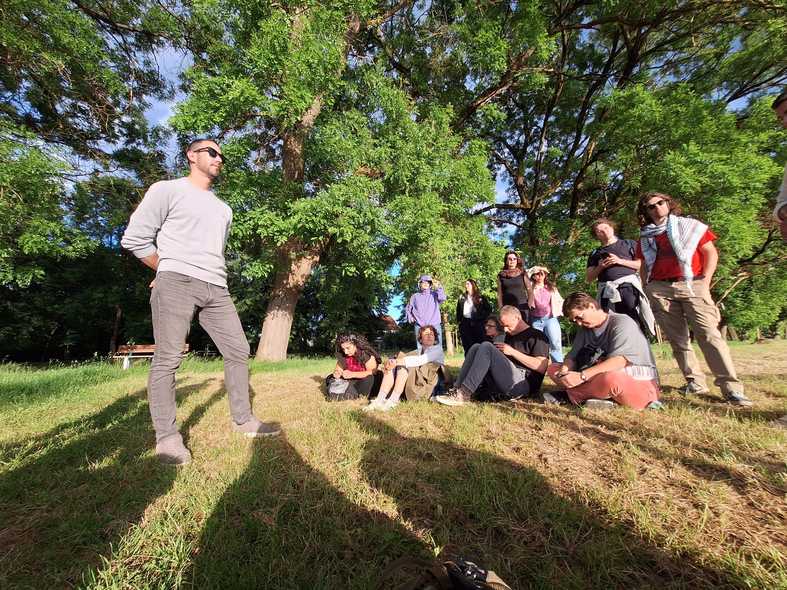
The program of the visit was diverse and took place in several cities, in order for participants to gain a more comprehensive insight into interethnic cooperation and ways of overcoming divisions in Croatia, as well as into the work of civil society and artistic organizations that in various ways work on promoting reconciliation.
On the first day we were in Vukovar and visited the Ovčara Memorial Site. We had the opportunity to see how war affects a community and what consequences it leaves behind, but also what we, as citizens of such a community, can do in order for peace to truly be established and for the divisions created by war to be overcome.
Since Vukovar is not only a place of divisions and conflict, we took part in a memorial walk which gave us insight into contemporary life in the reconstructed city.
We ended the day at the European House Vukovar, where we were presented with the beginnings of their work and the ways in which civil society organizations, despite often discouraging social contexts, can actively contribute to reconciliation processes.

The following day we were in Osijek. From early morning we were in the field and first visited the Museum of Personal Stories, which in a unique way addresses themes of individual experiences of resistance and directs its work towards the individual and everyday life. The museum shows that every person carries their own story, but also an inner strength that is often invisible from the outside.

On the same day we also visited the Center for Peace, Nonviolence and Human Rights Osijek, which has been active for many years and continuously aligns its work with current social needs. We had the opportunity to hear more about the prerequisites for their long-term and successful work, among which are especially emphasized faith in change, perseverance despite challenges, and above all, people who share the same vision.
The program then took us to Petrinja, where we were hosted by Mario Mažić, one of the founders of the Youth Initiative for Human Rights in Croatia. Petrinja is a city marked not only by war events, but also by the 2020 earthquake, which additionally affected its urban and social landscape.
Despite numerous challenges, the city is still alive. Through a guided walk in Petrinja, Mario provided us with a broader socio-political context of Croatia, with a special emphasis on local specificities. This encounter enabled us a deeper and multidimensional insight into the divisions that are still present today.

After Petrinja we headed to Zagreb. To begin with, we were guided through the city by Saša Šimpraga, activist and publicist from Zagreb. Through a walk in the city center, we visited key memorial sites and analyzed how the (non-)commemoration of space is connected to broader social context and political agendas.

After the memorial walk through Zagreb, we visited Arterarij and the Center for Theatre of the Oppressed POKAZ – two organizations that through theatre create space for the visibility of marginalized groups and address topics that rarely find space in the public sphere.
On the last day of the program we attended the Zagreb premiere of the film Where Are You Going? organized by the Forum Sarajevo association. The film is an honest and emotionally powerful story about the resistance of the Academy of Performing Arts in Sarajevo and its role as a refuge for students before and during the war in Bosnia and Herzegovina.

After the screening, a discussion with the film crew followed, which gave us insight into the process of making the film and the personal and professional dedication they invested in it.
Participation in the study visit, both in the role of participant and as part of the organizing team, provided me with an exceptional opportunity for further development of skills, both in technical aspects of organization and in working with people. It enabled me to become familiar with new methodological approaches that I will be able to apply in my future, most likely human rights-related work.
The tour of Croatia in this way left a different impression on me than on participants from other countries, but I still consider it an extremely useful experience. It took me out of everyday routines and dominant media narratives and showed that people across the country have been systematically working on issues of interethnic cooperation and reconciliation for years.
As a sociology student, it is especially valuable for me to meet people outside my immediate professional and academic circles who are close to the same topics and who have been working on them in the long term and with dedication. This gives me additional motivation and a sense of purpose regarding my own future and the society in which I live.
What will remain most in my memory are the people who participated in the visit – from colleagues from YIHR Serbia, Urban Gorillas from Cyprus and the University of Rijeka to all other participants. Through conversations about their countries and current social contexts, I learned more than I could on my own.
Although our experiences are shaped by different contexts, similar parallel structures can be recognized in their depth, which makes such programs and visits extremely valuable. They enable the exchange of knowledge, insight into different approaches to work, and mutual learning and application of good practices in one’s own work.
- The author of the text is Nikolina Palac, a sociology student in Zagreb and intern at the Youth Initiative for Human Rights Croatia.
Funded by the European Union. The views and opinions expressed are those of the author only and do not necessarily reflect those of the European Union or the Agency for Mobility and EU Programmes. Neither the European Union nor the granting authority can be held responsible for them.